Map Infographic Presentation Template: A Practical Evaluation
In the landscape of modern business communication, data visualization has shifted from a nice-to-have feature to an essential requirement. Professionals across various sectors—from marketing agencies and educational institutions to startups and established corporations—constantly seek ways to present complex geographical data with clarity and impact. The Map Infographic Presentation Template addresses this specific need by offering a structured framework for visual storytelling. Rather than starting from a blank canvas, which often leads to inconsistent design choices and wasted hours, this tool provides a pre-designed environment where users can focus on content refinement rather than layout mechanics.
The primary value proposition of this template lies in its ability to streamline the creation of location-based narratives. Whether you are tracking sales performance across regions, illustrating demographic shifts, or mapping out logistical routes, the visual representation of data is critical. This template is not merely a collection of static images; it is a functional resource designed to integrate seamlessly into existing workflows. By leveraging the Map Infographic Presentation Template, users can ensure that their presentations maintain a high standard of professional aesthetics while remaining fully adaptable to specific brand guidelines.
Core Functionality and Design Flexibility
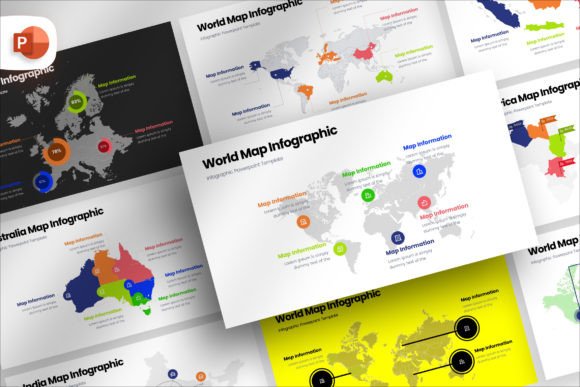
At the heart of this resource is a comprehensive library containing 87 unique slides. This volume suggests a robust toolkit capable of handling diverse presentation scenarios without requiring repetitive slide duplication. Each slide is crafted with a 16:9 aspect ratio, aligning with the current industry standard for widescreen displays and projectors found in most conference rooms and digital meeting platforms. This ensures that the content fills the screen appropriately, avoiding awkward black bars or distorted imagery that can undermine credibility during a live pitch.
One of the most significant technical advantages is the drag-and-drop functionality integrated into the picture placeholders. In many generic templates, inserting an image requires manual resizing and alignment, a process that often breaks the layout's harmony. Here, the system automatically adjusts the size, transparency, and shape of inserted images. This automation reduces the friction between idea and execution, allowing the presenter to swap out stock photos or custom graphics instantly. The result is a polished look that feels bespoke, even when built rapidly.
Furthermore, the template supports full customization of shapes, colors, and positions. This level of editability is crucial for maintaining brand consistency. A marketing team, for instance, can easily replace default blue tones with their corporate palette without needing advanced graphic design skills. The fonts used in the document are included in a dedicated folder with a free license, removing the common hurdle of missing typefaces when sharing files across different computers. This attention to detail ensures that the final output looks exactly as intended, regardless of the recipient's software environment.
Real-World Application and Workflow Efficiency
When evaluating the practical utility of the Map Infographic Presentation Template, it is helpful to consider how it performs under pressure. Imagine a scenario where a logistics manager needs to present a new distribution network strategy to stakeholders within a tight deadline. Using a standard PowerPoint interface would require building map markers, drawing connection lines, and formatting text boxes individually—a time-consuming task prone to errors. With this template, the manager can select a relevant map layout, input the data points, and adjust the color coding to highlight efficiency gains. The workflow becomes linear and predictable, significantly reducing the time spent on administrative design tasks.
The inclusion of complete mockup devices adds another layer of professionalism. For freelancers and consultants pitching services to potential clients, showing how a mobile app or website interacts with geographic data can be compelling. The template allows users to simply drag and drop a screen placeholder into a device frame (such as a smartphone or tablet). This feature transforms abstract concepts into tangible visuals, helping the audience visualize the end product more effectively. It bridges the gap between technical specifications and user experience, making the presentation more persuasive.
However, it is important to note the limitations regarding image assets. The package does not include image stocks, meaning users must source their own photographs, maps, or icons. While this offers total creative freedom, it also places the responsibility of finding high-quality, legally compliant visuals on the user. For those who rely heavily on stock photography libraries, this is a manageable constraint, but it does add a step to the preparation process. Users should plan their asset sourcing before diving into the slide assembly to maintain momentum.
Target Audience and Strategic Fit
The versatility of the Map Infographic Presentation Template makes it suitable for a wide range of professionals aged 20 to 50. Entrepreneurs launching location-based startups will find the extensive slide variety useful for investor decks. Educators can utilize the clear visual structures to explain historical events or scientific phenomena involving geography. Small business owners looking to analyze local market trends can leverage the customizable charts and map overlays to make data-driven decisions.
For marketers and bloggers, the ability to create consistent, branded content quickly is a major advantage. The template supports the creation of recurring reports or case studies where visual consistency builds trust with the audience. Even serious hobbyists presenting at conferences or community groups can benefit from the elevated aesthetic, ensuring their passion projects are taken seriously. The documentation file included in the package serves as a guide for navigating these features, making the learning curve relatively shallow for non-designers.
Despite its strengths, the template may not suit every single use case. Highly specialized technical presentations requiring interactive, real-time map data integration might exceed the capabilities of a static PowerPoint format. Additionally, users seeking a "one-click" solution that includes premium stock photography will need to supplement this tool with external resources. However, for the vast majority of static presentation needs, the balance between flexibility and structure provided here is optimal.
Long-Term Value and Reliability
Investing in a high-quality presentation asset like the Map Infographic Presentation Template offers long-term value beyond a single project. Once a user masters the customization options—adjusting shape sizes, repositioning elements, and managing color schemes—they can reuse the base structure for future initiatives. This creates a standardized visual language for an organization, enhancing brand recognition over time. The reliability of the file structure, with all necessary fonts and mockups contained within the package, ensures that the template remains usable years down the line, even as software updates occur.
The emphasis on clean code and editable vectors means that the slides do not degrade in quality when resized or printed. This durability is essential for materials that may be distributed in both digital and physical formats. Whether projected on a massive LED wall or printed as handouts for a board meeting, the integrity of the design holds up. This reliability reduces the risk of technical glitches during critical moments, providing peace of mind to the presenter.
Ultimately, the decision to adopt this tool depends on the user's need for efficiency and visual coherence. If the goal is to communicate complex spatial information clearly and professionally, without getting bogged down in design minutiae, this template delivers on its promise. It empowers users to shine in every presentation by shifting the focus from "how do I make this look good?" to "what story am I telling?" By providing a solid foundation, the Map Infographic Presentation Template allows the content itself to take center stage, ensuring that the message stands out in a crowded marketplace of ideas.